
Why every company should cultivate Rethink Data

Don’t (Merely) Hoard Data — Put It to Work

Business leaders and data managers are in a race to keep up with today’s unprecedented data growth and data sprawl. To find and leverage the value in the continuous data torrent flowing across networks between data centers, multicloud platforms, and the edge requires a more dynamic approach to managing the movement of data.

The complexity of data architectures and data locations compounds these challenges.

Now, a new report by Seagate, Rethink Data: Put More of Your Business Data to Work — From Edge to Cloud, discusses why companies must find new ways to gain business value from a plethora of data being generated from the edge to the cloud. The report draws on research conducted by IDC, and is based on a survey of 1,500 IT executives from around the world. You can read the full report here.

The good news is that there is a solution to today’s data management dilemmas: DataOps — a discipline of connecting data creators with data consumers. Business leaders who opt to implement DataOps can count on better business outcomes, such as increased customer satisfaction and higher profits.

The Rethink Data report underscores why DataOps is essential for data management, why companies need to get a better handle on “data in motion” and the processes supporting AI and data analysis, and how multicloud platforms are becoming the new normal for many enterprises.

DataOps: The Missing Link of Data Management

The report’s bottom line: Enterprises of all sizes need a more integrated approach to data management. DataOps — an emerging discipline designed to improve the speed, quality and value of data analytics — is the missing link. Businesses can, for example, apply the DataOps model to the iterative learning process that artificial intelligence (AI) applications require. This differs from a traditional data analytics approach. Instead of searching for an answer to a specific problem, DataOps makes data associations and searches
for insights. Using a DataOps philosophy, enterprises take a more holistic view of their data.

A majority of IT leaders surveyed by IDC for the report said that DataOps is “very” or “extremely” important to their organization. However, only 10% reported that their companies have fully implemented a DataOps solution.

Implementing DataOps requires that data consumers — business owners and line-of-business leaders — seek a clear understanding of how and where data is gaining in volume, and what data should be collected from myriad sources, from endpoints and IoT devices to the people who generate reports and information that is fed to decision-makers. Improving data flow and analytics can increase productivity and speed up the innovation process.

A DataOps approach can help businesses manage data from multiple parts of an enterprise more effectively. “Being able to correlate data from disparate sources is a capability not easily available through other means,” the report notes. “Because it is difficult, those organizations able to master it can expect to have an edge over the competition.”

In addition, a DataOps strategy would use machine learning to automate the process of aggregating and analyzing data from multiple sources such as core, cloud and edge devices. Machine learning models can learn from the data itself, becoming more precise over time. Using machine learning enables enterprises to gain insights from data that might otherwise be overlooked by a human analyst.

DataOps can, for example, provide retailers with insights about why shoppers purchase unrelated items. Armed with that information, retailers can improve marketing strategies to target more interested customers, adjust merchandising mixes and refine product placement to increase sales where there is demand.

Manufacturers can apply the DataOps discipline to collect and analyze data on the performance of machines so they can improve maintenance efficiency and uptime. Machine learning also enables an enterprise to more intelligently scale its ingestion of data flowing in from thousands of IoT devices located throughout a production facility or distribution center.

68% of Data Goes Unused — A Devastating Loss of Value

According to the report, 68% of the data available to enterprises goes unused, and failing to analyze data in today’s economy means leaving money on the table. AI-driven automation can help companies access and put to use data scattered at the edge, in the cloud and in data centers. Companies that use AI as part of a DataOps approach to analytics can increase their ROI from improved productivity and new business insights.

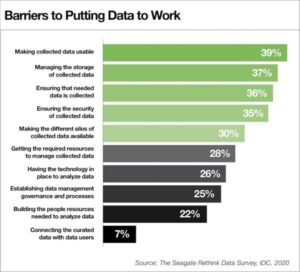
Organizations face five key challenges that they believe limit their ability to exploit the full potential of collected data:

  1. Making collected data usable
  2. Managing the storage of collected data
  3. Ensuring that needed data is collected
  4. Ensuring the security of collected data
  5. Making the different silos of collected data available

These considerations should matter to business owners because they directly affect the value of data that businesses can uncover, which affects revenue.Better management of siloed data from multiple sources can translate into business growth. Business leaders surveyed in the Rethink Data report say they only use 32% of the data available to them. That means a lot of data is wasted. “Every business is a data business,” says Naik. “But enterprise data is of little value if it is not used.”

Data management solutions should focus on resolving these challenges to provide the most effective experience possible for both business owners and customers, and begin to help businesses chip away at the percentage of data that they are unable to exploit.

“The findings of this study illustrating that more than two-thirds of available data lies fallow in organizations may seem like disturbing news,” said Phil Goodwin, research director at IDC and principal analyst on the research survey. “But in truth, it shows how much opportunity and potential organizations already have at their fingertips. Organizations that can harness the value of their data wherever it resides — core, cloud or edge — can generate significant  competitive advantage in the marketplace.”

“The more pieces you put together, the bigger a puzzle you can solve,” says Ravi Naik, Seagate Chief Information Officer and Senior Vice President, Corporate Strategy. “You can tackle a much higher-order problem if you share data, cross-referencing various streams of information for analysis.”

Machine learning helps companies analyze data in real time to determine what is valuable and what is superfluous. AI-driven processes, such auto-pruning, can automatically archive data that is not immediately needed.

Ultimately, machine learning helps businesses gain more value from their data. Grocery stores, for example, collect data on product sales that helps them determine inventory mixes. In healthcare, hospitals can track patient volume to estimate costs in order to more efficiently predict and manage budgets.

Scroll to Top